Call us (912) 674-0619
 goldenislesfae@gmail.com


The most unglamorous thing we do. And the one that serves as a bulwark to all other things we do. It's just like shaping the land so water does what you want. And to have a solid foundation to what you are going to build on top. It's grading.
On such a flat coast, that is not so easy.
What grading actually is
Grading is a process by which we dig some places and fill other places and create intentional slopes in between. It's not like clearing which is getting rid of what's growing. It's not like excavation which is digging holes for a particular purpose.
There are 2 different kinds:
Rough grading set the general shape and drainage. Cut and fill. Big movements of material. Compacting while you go. This is the structural part.
Finish grading last few inches. Smoothing. Refining. Getting ready for turf, seed, driveway, slab.
You generally need both and the rough part is where the money and the impact is.
The one number that matters
For residential soils... I would say the rule of thumb is to slope away from the house at a rate of say six inches over the first ten feet from a structure.
So that's about a 5% slope. Most people don't expect that. The idea is that it's a slope, as opposed to a flat yard. Sure after the first 10' you can slope less... but it's got to be going somewhere.
For non-structures, you want a slight but definite slope to your lawn (say 1% to 2%). So water moves but it doesn't feel like it's on an angle.
The common failure mode is flat, or in the worst cases sloped towards the structure.
Why this coast is difficult ground
Three factors working against you.
It is flat. We have little natural topography in Glynn County. You need to have somewhere for the water to go. It may not just be there.
The water table is high. For lots that are low or close to marshes, the ground water is very close to the surface. With heavy rain, the soil is already almost saturated so it doesn't have anywhere for the water to go. Surface drainage is more important, not less, because you can't count on infiltration.
The soils are awkward at both ends. Sand drains quickly but also erodes quickly. You have to be careful or it will not keep a shape. Clay will hold water but expands and contracts. You often have a mix of both, in layers, but it is completely different.
Add our summer rain (we get rain in hard bursts, not just gentle rain) and hurricane season from June to November. You need a plan for the water and it needs to be deliberate, not just hoping for the best.
Signs your property needs grading
Water stands after rain. The biggest tell. If puddles last longer than a day, you have nowhere for the water to go.
Water against the house. Moisture on the bottom of the walls, water in crawl space, moisture along a strip of the foundation. This is the big deal because this is the version of this problem that is bad for the building.
Erosion. Channels in the lawn or bank. Soil running onto the driveway or walkway. Mulch is constantly moving. This is fast water that isn't being controlled.
Soggy ground that never dries. An area that won't let you mow without rutting. It won't grow grass. Moss is taking over.
Mosquitoes. Standing water is a breeding zone. This isn't a small quality of life thing on this coast.
A settling patio, drive or slab. Often a compaction failure under the surface, not the surface.
A leaning fence line along a wet run. Posts will fail where they're wet. We cover that in why fence posts fail in sandy coastal soil. Sometimes the problem is not the fence.
When grading is part of a bigger job
Before a build or a slab. Non-negotiable. Need to shape a pad, with the proper fill and proper compaction or else the pad will settle in all sorts of ways. Left over organic matter will decompose in the ground creating voids.
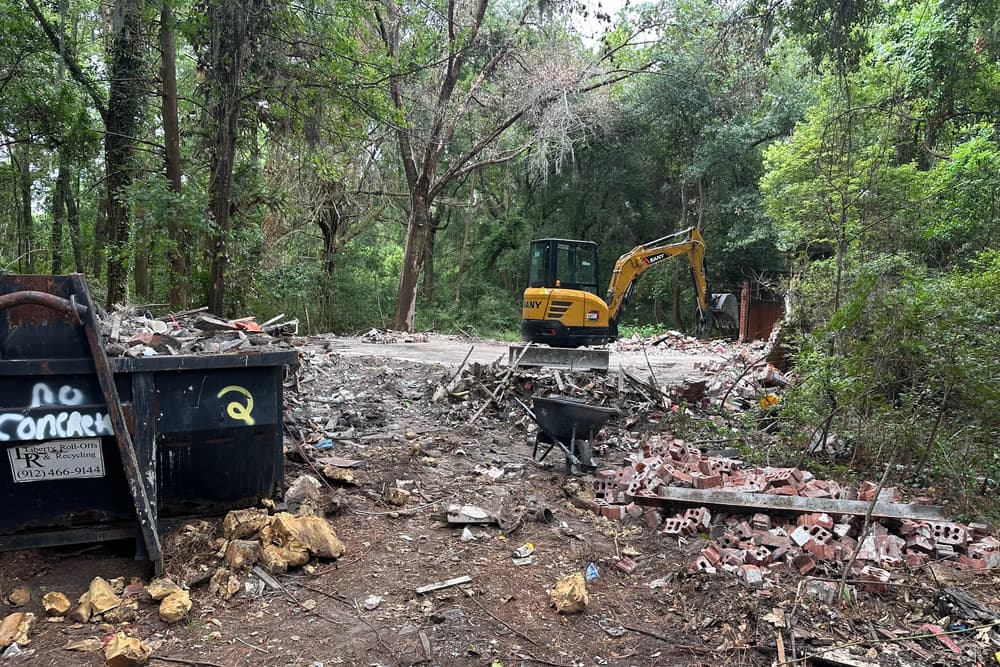
After land clearing. Clearing means you remove vegetation. You don't end up with a flat land suitable to build on. You end up with holes from stumps, ruts and spoil. Grading is a different operation that turns the land cleared into land that is usable. Typically everyone budgets for the first half of the process only. See land clearing.
Before a driveway. The quality of a driveway is only as good as its base. Shaping and compacting and crowning to shed water is what prevents rutting or washing out.
Before a pool or a deck. Both require flat stable well drained ground. Both require access for the construction equipment to get to it. See decks and porches.
With new turf. Putting sod down over wet ground means wasting money on grass that won't grow.
Alongside fencing. Sometimes need to adjust ground level for a fence line that crosses a swale or bank.
What it costs
Land grading is priced by the job, not the acre. It varies widely. A small residential job, say a fix-it to a problem area or correction to a fall around a portion of the house, often falls in the range of $1,500 to $5,000. A larger job with a significant amount of cut and fill or import material or a complete building pad can be far more.
Driving factors are:
- Volume of material moved (primary factor)
- Whether material has to be imported or exported. Imported fill dirt (or hauled out spoil) is charged by the load. See hauling.
- Access for equipment. It's higher by the cubic yard on tight suburban lots than wide open spaces.
- Obstacles (trees to work around, existing structures, utilities or irrigation)
- Compaction requirements. Land grading under a slab is a different ballgame than lawn grading.
- Erosion control, maybe required by permit (for larger disturbances).
Of course as usual no one can quote it by description. You have to have someone there to see water existing and potential.
Permits
If you disturb a lot of land you'll probably need to get a permit and have an erosion and sedimentation control plan. It will depend on local regulations and the amount of land you disturb. Call Glynn County Community Development (or your city) to find out.
A couple of other things specific to here to be aware of. You can't simply fix your drainage problems by dumping on your neighbor. That's a fight and sometimes a liability issue. If any of the work you're doing is around tidal marsh or wetlands you might want to put a halt on things and check things out. (See clearing near marsh and wetlands.)
Get someone to look at where the water goes
Diagnosing drainage issues requires a site visit, preferably in or immediately after rain. All we need to know is where the water comes from, where it collects and where it can possibly go to. None of that is evident from a picture on a dry day.
We do grading in all of Brunswick, St. Simons Island, Jekyll Island & surrounding counties. See our grading & excavation pages for more details.
Ask for a free site visit or give us a call (912) 674-0619