Call us (912) 674-0619
 goldenislesfae@gmail.com


You don't replace your fence because the boards are worn out, you replace it because the posts failed. If a few posts fail then there is no point fixing it.
All the expensive bits of a fence are underground. Especially important to realize in this part of the world, because our soil is terrible.
What we are building into
In the Brunswick and island area, the soil can be different in different areas within the same street, but it tends towards one of these two unhelpful ends:
Sand. In areas (especially near water and islands) there's sand. Sand drains amazingly, and it grabs horribly. There's almost zero lateral force provided. All the post's strength in the sand is determined by the size and depth of the footing. And it can move: water moving through it will cause fines to be lost and slowly grow the void around a footing.
Clay. Or there's clay (more inland areas). Clay grabs nicely, and drains horribly. It'll hold water to the post. It will expand and contract as it gets wet and dry, attacking the footing over the years.
And then a high water table. Especially in low-lying areas and near marshes, a post hole can start filling with water while you're digging it. It's not rare here. It's a Tuesday.
And with constant humidity, heavy rain in summer, salty air. You've got an environment that's trying to kill the post in a bunch of different ways.
The four ways posts fail
Rot at the ground line
The classic. It's not that the wood post rots all the way through. It's that the rot happens in a narrow strip just at the soil surface. That's where the water and oxygen are. Further down, it's saturated soil so it's lower on oxygen. Up above, it's dry wood.
So you get this perfectly good looking post up out of the ground but it's all hollowed out exactly where all the bending stress is. That's how a fence can be looking good in May and be flat as a pancake in September. The classic thing is push your screwdriver into the post at grade. If it goes in, the post is dead.
Almost always it's just the wrong wood. Using above-ground rated treated pine in the ground? That fence doesn't have a long life. Ground-contact rated treatment is not an upgrade here, it is the requirement.
Water pooling in the footing
You got an install fault. It's extremely common.
If you pour the concrete in the hole and finish it flat or worse, dished below the grade. Then the top of that footing is like a saucer. Every time it rains it collects water and holds it against the post. You've created a small reservoir of water at the point you want dry.
Now when you do it correctly, you crown the concrete away from the post. On all sides so it sheds the water. It takes 30 seconds per post. And it adds years.
Sometimes the installer will bed the wood post with gravel at the bottom of the hole. So water will drain somewhere other than sitting on the end grain. We have sandy soils so it's a good idea.
Insufficient depth, especially in sand
It's generally about a third of the above ground post height that should be in the ground. For a 6' tall fence you would want about 2' below grade. In sand, the more below grade, the better.
The physics of it is that when the wind blows on your fence it's trying to spin the post around a pivot point at or near the bottom of the footing. The deeper the post, the longer your lever arm to resist this rotation and the more soil you get involved. When you have shallow posts in the sand they tend to start levering out slowly over time. You end up with fences that appear to be leaning a bit more every year.
The other thing to consider is the size of your hole. A hole just slightly bigger than your post results in a narrow footing that cuts like a knife in the sand. A bigger hole means you have a footing with some real surface area to bear on.
Wind load the posts were never sized for
A 6 foot solid privacy fence is a constant sail. It will have to withstand real pressure in June to November (hurricane season).
The key is in the post spacing. A 6-8 foot solid fence post spacing is what you want. If you try to save some post holes by going out to 10, the remaining post load goes up a quarter or more. These are the ones that collapse.
Gates are a special challenge and often not built strong enough. A gate is hanging the full weight off of one post. Every time you close the gate it impacts that post with the whole weight. You need a bigger (diameter) deeper, more heavily concreted gate posts than line posts. Usually when you start getting gate drag it is the post moving, not the hinge.
How posts should be set here
- Ground-contact rated pressure-treated timber, for everything going into the ground, every time.
- Depth of about a third of the above-ground height. In loose sand, more.
- A hole comfortably wider than the post. (To get the footing area)
- Gravel at the base, so the draining water in the hole has someplace to go.
- Concrete crowned above grade. Down-sloped. So the footing is shedding, not holding, water.
- Six to eight foot spacing on solid fence. (On wire you can go wider for the wind to blow through.)
- Oversized gate and corner posts. Always.
- Hot-dipped galvanized or stainless fasteners. (Salt air will kill the hardware, too.)
Nothing here is exotic. This is twenty year fence vs. eight year fence. In the final picture, it's almost impossible to see. So that's why cheap quotes can look just like good quotes.
What about steel and vinyl posts?
Steel posts inside wood fence (more and more common) solves rot issues nicely (as long as you have suitably galvanized or coated steel). Uncoated or thinly coated steel in coastal soil will swap rot for corrosion.
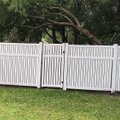
Vinyl posts are hollow tubes (often concreted in. Often partially filled with concrete for rigidity). They can't rot (which is one of the major benefits of vinyl fencing). But they are completely dependent on footing. You can't straighten a vinyl fence later, so your footing must be perfect to begin with.
Aluminum posts has very little wind load because it is open. That's a big part of why aluminum fencing is so good on exposed coastal lots.
When the ground is the actual problem
Not always the post problem. If after a rain you have water pooled along the fence line for days. No amount of post detail is going to keep it going for ever.
On flat, low fall lots, if you can correct the drainage, not only will you help your fence but your yard and often house. This is a grading problem, not a fence problem, but worth correcting once and not re-building your fence over and over again.
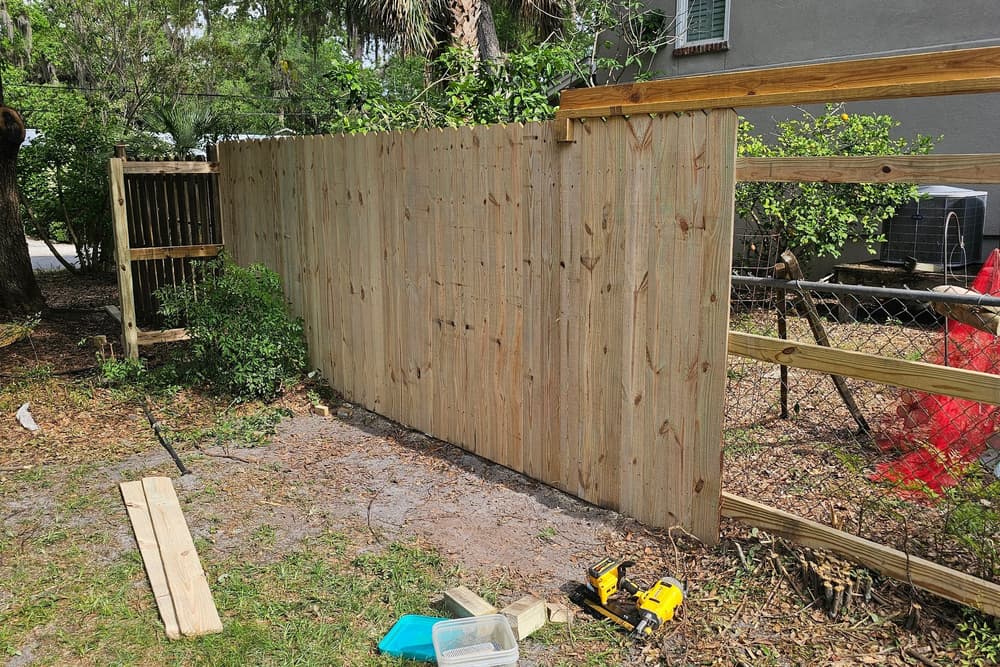
If your fence is already leaning
Push the posts, chest high, and see how many you can drive in with a screw driver. Try to test the bottom of the post.
If you get a couple of bad posts in an otherwise good fence, no big deal. It's a simple fix. But if you get more than a third of them bad, then you're in rebuild mode. You're just flushing money away trying to patch a fence that is going to need more attention. We'll come over and let you know. Check out fence repairs and our guide for storm damage.
Get a free assessment or call (912) 674-0619, and we'll walk the fence and let you know.