Call us (912) 674-0619
  goldenislesfae@gmail.com
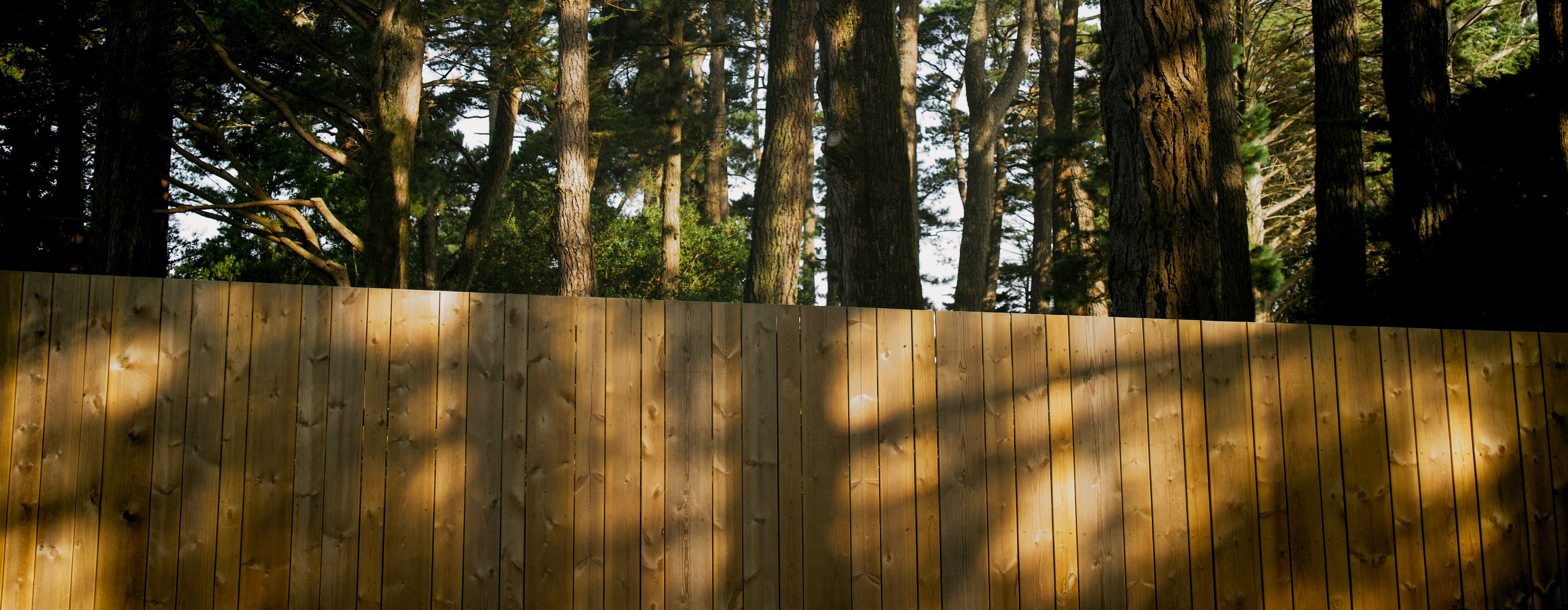

The honest answer is that nobody can quote your fence from a blog post. What we can do is show you the ranges we see around Brunswick, explain what pushes a job toward the top or bottom of them, and save you the surprise of a number you were not expecting.
Everything below is a rough estimate for planning, not a price. Coastal sites vary enormously, and the only figure that means anything is the one written on a quote after somebody has walked your property.
Fence cost is measured per linear foot
Fencing is priced by the running foot of fence, not by the square foot of your yard. So the first thing worth doing is walking your property line with a tape measure or a measuring wheel and writing down roughly how many feet you want to enclose.
A typical quarter-acre lot in a Brunswick subdivision often needs somewhere around 150 to 250 feet to close in a back yard, depending on how much of the perimeter the house itself takes up. An acre enclosed on all four sides is more like 800 feet. The jump between those two is why "how much is a fence" has no single answer.
Rough installed ranges by material
These ranges cover materials and labor, installed, for standard residential heights. Treat them as a starting point only.
- Chain link — roughly $15 to $30 per linear foot. The cheapest way to enclose a yard, and still the practical choice for dog runs and back boundaries where looks are not the point.
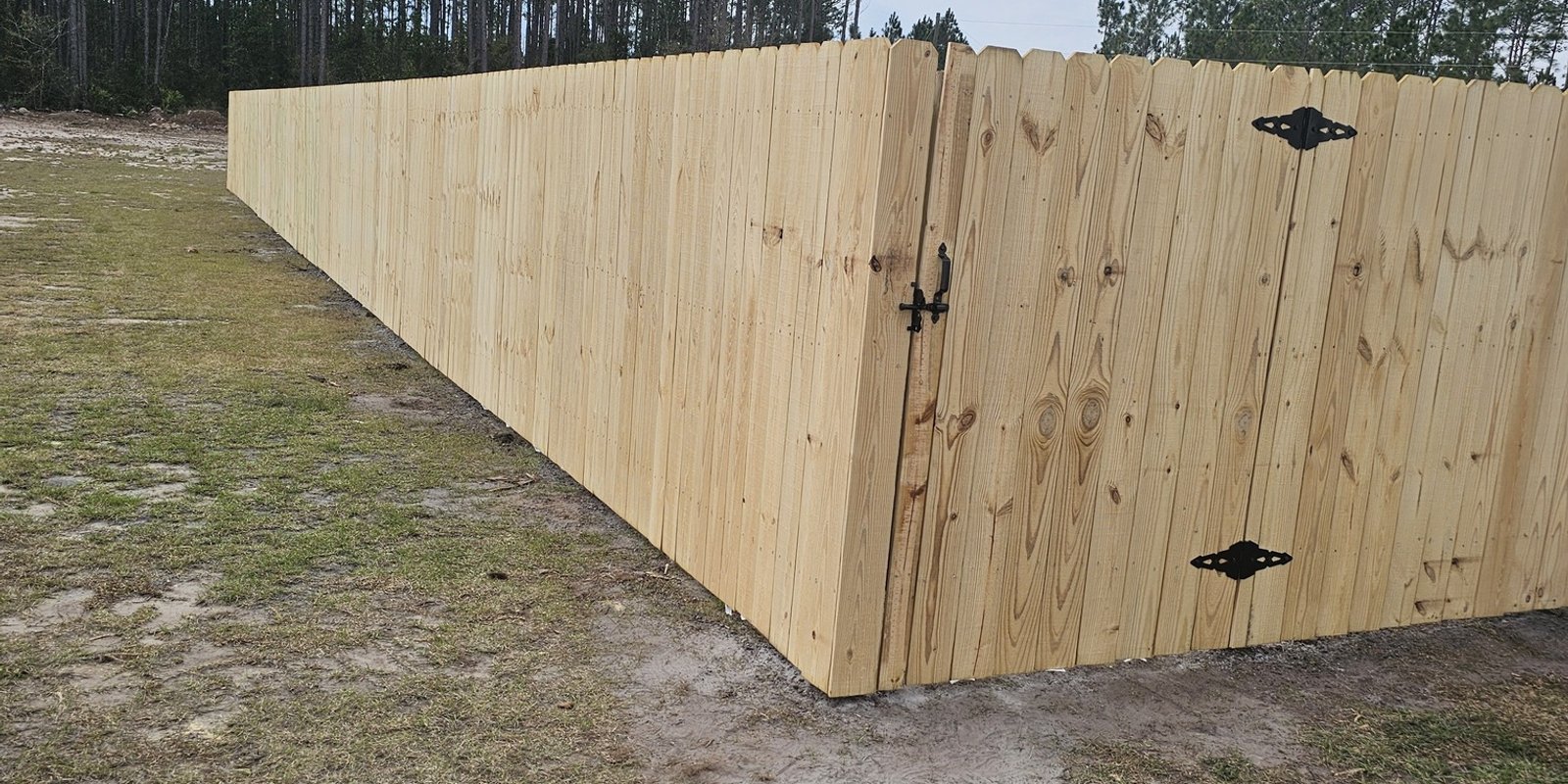
- Wood privacy — roughly $25 to $45 per linear foot. Pressure-treated pine at six feet is the default in this area. Height, picket style and whether you want a finished side facing out all move this.
- Vinyl privacy — roughly $35 to $60 per linear foot. Costs more up front than wood and asks almost nothing of you afterwards.
- Aluminum ornamental — roughly $40 to $75 per linear foot. The premium buys you a fence you can see through, powder-coated and genuinely comfortable in salt air.
- Field and farm wire — roughly $6 to $15 per linear foot. Acreage fencing is a different world, and the per-foot number drops sharply once you are running long straight lines.
If you want the detail behind any of these, we have pages on wood fencing, vinyl fencing, aluminum fencing and field fencing that go into the specifics of each.
What actually moves your number
Gates
Gates are the single most underestimated line on a fence quote. Every gate is a small piece of engineering: posts sized to carry a swinging load, hinges and latches that have to survive coastal air, and sometimes a drop rod and a concrete footing. A simple walk gate adds a few hundred dollars. A wide double drive gate can add well into four figures. Two gates instead of one is a real cost decision, not a detail.
Access
Can a truck and a trailer get to the fence line, or is everything going through a three-foot side gate by hand? Tight urban lots in Old Town Brunswick and dense island streets on St. Simons often mean materials are carried, spoil is wheelbarrowed out, and a post-hole auger cannot reach half the line. That is labor, and labor is most of a fence.
Ground conditions
This is the local one. Our soils run sandy near the water and turn to heavy clay further inland, and the water table on a marsh-front or low-lying lot can be surprisingly shallow. A post hole that fills with water changes how the hole has to be dug and how the post is set. Roots from live oaks and old pines, buried construction debris on newer subdivisions, and the occasional slab of forgotten concrete all slow a crew down.
Slope and obstacles
Most of Glynn County is flat, which helps. But a fence that has to step down a bank, cross a drainage swale or work around an existing shed still costs more than a straight run across level ground. If the line needs clearing first, that is its own job — see land clearing and grading.
Removal of the old fence
Taking out an existing fence and hauling it away is real work, especially if the old posts are set in concrete. Ask whether removal and disposal is inside the quote or beside it.
Where the coast adds cost, and where it saves you
Salt air is the local tax on cheap hardware. A fence three miles inland and a fence on Sea Island are the same fence, but the second one needs fasteners, hinges and latches that will not be a rusty smear in two years. Hot-dipped galvanized or stainless hardware, and powder-coated aluminum instead of bare steel, cost more on day one and cost far less across ten years.
Hurricane season runs June through November, and that shapes choices too. A solid privacy fence is a sail. Some owners on exposed lots deliberately choose a semi-private or picket style, or aluminum, simply because wind passes through it. That is not a cheaper fence, but it can be a cheaper decade.
Cheap fences are usually expensive
The temptation on a tight budget is to go shorter on post depth, wider on post spacing, and lighter on hardware. In sandy coastal soil, that is exactly where fences fail. A fence that leans after three years and needs rebuilding after six has cost more than the one that was quoted a few hundred dollars higher.
If you are comparing quotes, look past the total and ask about post depth, post spacing, concrete, and what the fasteners are made of. Two quotes that look the same on the bottom line are often not the same fence at all.
Getting a number that means something
A useful quote needs someone on the property. We look at the line, the access, the ground, where the gates want to be, and what the neighbors already have. Then you get a figure you can actually plan around, along with an honest steer on where you could spend less without regretting it.
We work across Brunswick, St. Simons Island, Jekyll Island and out through Glynn, Camden and McIntosh counties — there is more about our coverage on the Brunswick fence company page.
When you are ready, get in touch for a free quote or call us on (912) 674-0619. Walking the line with you costs nothing, and it is the only way either of us finds out what your fence really costs.