Call us (912) 674-0619
 goldenislesfae@gmail.com


The first thing to go when storms hit, and the least likely thing people will adequately insure is a fence. If you've been through a storm in the Golden Isles, what you do in the first hour will often separate a claim from a fight.
This is the order you need to do things.
First: make it safe, then photograph everything
Before you do anything, scan for hazards. Could be a limb has fallen across a power line. Could be a part of the fence that's leaning is only still standing because of tension and will fall the second you try to move it. Don't get near if there's even a chance there's a power line down. Call the utility.
Now take pictures. Before you do any clearing.
- Wide shots Pictures of the entire fence line. Showing how it's positioned relative to the house and the yard.
- Close-ups Pictures of each broken piece. Each fractured board. Each snapped post. Torn up hardware.
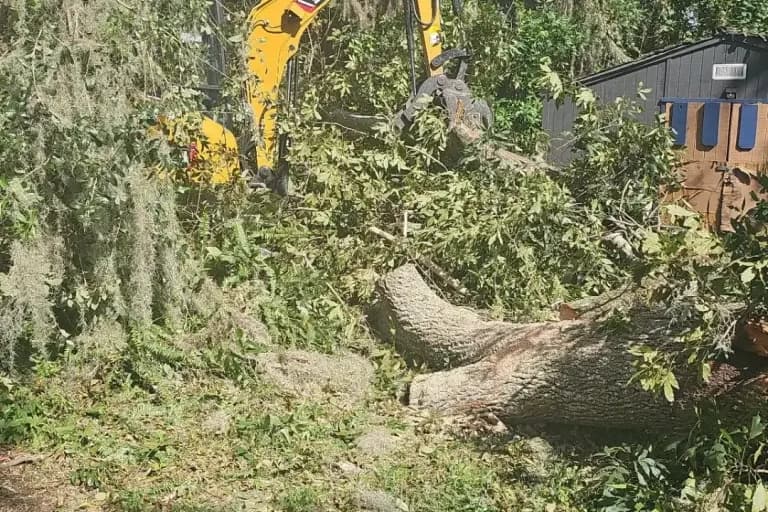
- The cause If you can see them. The fallen limb. The tree it fell from. The debris that hit it.
- Date stamps. Phones do this automatically. Don't mess with the metadata. Don't crop. Don't edit.
Take pictures of the good parts as well. Shows what the fence was like. Makes the storm damage more obvious rather than years of neglected rot.
Try to dig up pictures of the fence from before the storm. (In the background of a barbecue picture. Yard project. Listing picture). Often the condition prior to the storm is the key.
Second: read your policy before you call
Homeowner standard policy coverage for fences would probably be considered as "other structures", not dwelling. That has a few implications:
The limit is separate. Often, the other structure coverage is a % of your dwelling coverage. Also, other structure can include detached garages and sheds etc so the fence claim is a grab out of the same pool.
The deductible applies. Often times, it can be cheaper than your normal deductible to fix a fence making it not worth filing a claim. Make sure to get a sense for how much it'll cost to fix it.
Named-storm deductibles exist. Coastal Georgia policies often have hurricane and named storm deductibles. These deductibles can be a % of the value insured (not a set amount). These deductibles can be much, much higher than your normal deductible. Make sure you know which you have before assuming you're covered.
Coverage is normally for sudden accidental damage from a covered peril, i.e. wind or tree falling on it. Normally it's not going to cover for rotting, termite damage, gradual leaning or if the fence failed from being worn out. Companies are going to look closely for this distinction (which is the other reason why good pictures are good).
Also, many policies settle with actual cash value (not replacement cost) for other structure coverage, so depreciation will be taken off a 15 yr old fence. Make sure you know which your policy settles as.
This is all info and not specific advice on your policy. Look at your policy or ask your agent. Policies vary a ton. Coastal policies vary most.
Third: whose tree, whose fence?
Most everyone's big surprise: in most cases when your neighbor's tree falls on your fence, it's going to be your insurance company and not theirs. In general a tree that is healthy and is uprooted by a storm is going to be considered an act of nature and not anyone's fault.
It may be different if you could obviously see it was dead, or sick or a danger and the tree owner was notified and ignored it. It may be a case of negligence. If that's what you have, it's as important as the pics of the damage to document your notices.
In other words, if you're looking at a dead tree now that's leaning toward your fence, notify the owner about it (and keep a copy of your notice).
Fourth: repair or replace?
The ultimate question when all the documentation and safety issues are addressed.
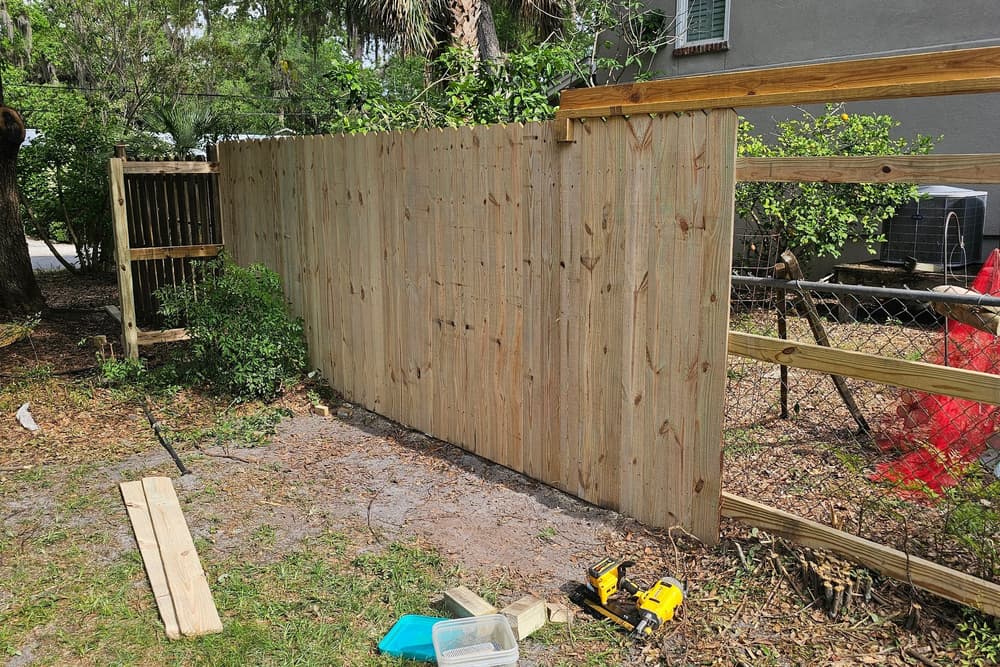
Repair usually makes sense when
- Some small areas damaged, rest OK
- The posts are intact. Biggest factor by far. The posts are costly and labor intensive. Boards and panels are cheap by comparison.
- It's not that old and the materials are still available.
- You can get pretty close to matching the existing material.
Replacement usually makes sense when
- Multiple posts have snapped or lifted. once they're gone you're rebuilding anyway. Fixing things around the posts means you'll end up with a fence with different lifespans in different areas.
- it's pretty much at the end of its life anyway and the storm just put an end to the argument.
- more than about a third of the run is trashed
- the product you've got is discontinued, as with vinyl panel systems.
- you're getting in the habit of fixing things all the time.
There's a middle ground here to consider. Replace a trashed run completely and fix the sound parts. A fence doesn't need to all be the same age.
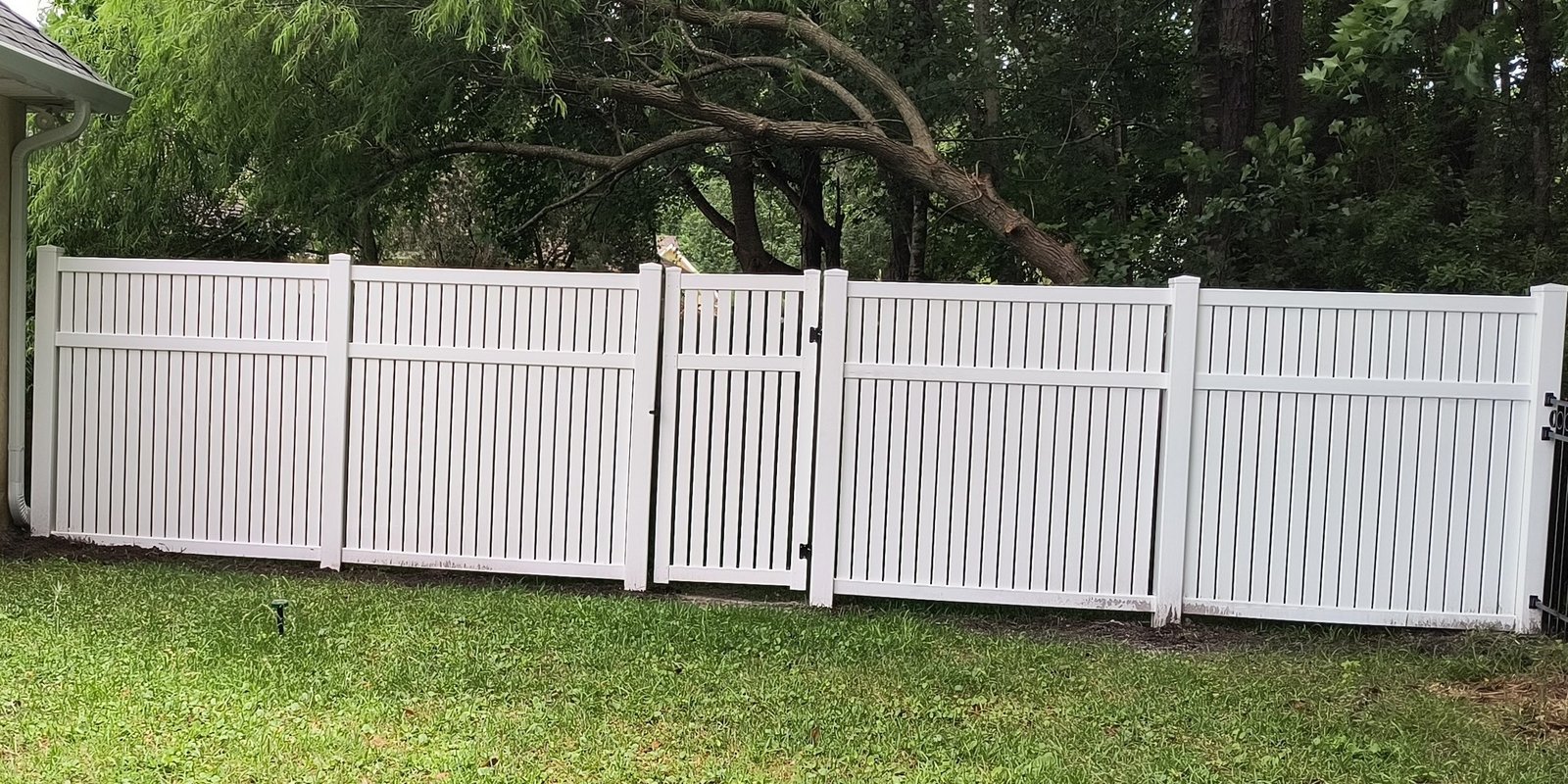
A note on matching. If you have new wood next to 15 year old weathered wood it's obvious for a couple of years and then it blends in. If you have new vinyl next to sun-bleached vinyl it's obvious forever. Keep that in mind as you make your choice. Check out our fence repairs page to see how we handle it.
Fifth: get the estimate before the adjuster decides
Get a written estimate from a fence contractor with an itemized list of materials, labor, post replacement, debris removal and disposal. Often, when the adjuster is using some general allowance and the contractor is using your actual fence, there is quite a difference. The one with the details is yours.
Save every receipt, even emergency measures to secure the site. (These are often recoverable.)
Don't allow anyone to remove the damaged material until it's documented and (if it's in a claim situation), until the insurance company has had a chance to inspect.
A word about storm-chasing contractors
Every big storm brings new teams of unknown people. Some are okay. Some want giant deposits. Some are shoddy. Some can't be reached.
When you are about to give people money: make sure they are local and will be available next year, get it in writing (with scope clear). Beware of being pressured to sign right away. Beware, even more, of someone saying they will "handle" your deductible. Not a favor. Not legal.
Building back better
Well, if you're already doing it then you might as well correct whatever went wrong.
If the posts broke at ground level it's likely they weren't ground contact rated or went in too shallow or not set right. If the entire panel just fell over in one piece then the posts aren't big enough for wind load. If hardware pulled out, then the wrong metal was used for salt air.
When you have a big open area lot, you might think of using a shadowbox or semi-privacy style, so that wind blows through, or aluminum fencing, which doesn't even blink at a storm. (We looked at wood vs vinyl vs aluminum.)
The only thing that is actually a mistake you could avoid here is doing it again to the same spec as what just failed.
We handle the whole thing
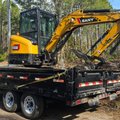
We provide storm fence repair and replacement in Brunswick, St. Simons Island, Jekyll Island and surrounding counties. We are well versed in providing the itemized documentation needed by insurance companies. If the fence goes down with a tree we can clear and haul it away. (See hauling)
Get in touch for a free assessment or call (912) 674-0619. Take a picture first. Then call us.