Call us (912) 674-0619
  goldenislesfae@gmail.com
Land clearing on St. Simons Island: selective clearing that keeps the oaks and stays out of the marsh
Nobody clears a St. Simons lot to bare dirt. The job is to take out what is in the way and leave what makes the island worth living on.
A wooded lot on St. Simons Island is a tangle of saw palmetto, yaupon, wax myrtle, volunteer pine and vines under a canopy of live oak, and somewhere in it is the house site, the driveway and the yard. Clearing it is not a matter of pushing everything over. Glynn County's tree protection ordinance covers the mature oaks, the marsh buffer restricts what can happen near the water, and the finished lot is worth far more with its big trees than without them. Golden Isles Fencing and Excavation clears lots on St. Simons selectively: understory and small trees out, specimen oaks in, marsh untouched.
We are a family-owned, Christian-based company based in Brunswick, and because we also grade and fence, we clear an island lot with the next steps already in mind.
Protected trees come first
On most of the island the live oaks are the lot. Glynn County protects mature specimen trees, and removing one is a separate approval that is slow, uncertain and often refused. Our approach is to treat the oaks as fixed and plan everything else around them. During the estimate we walk the lot with you, tag the trees to keep, and lay out where the machine can work. If a protected oak sits exactly where the house was drawn, the answer is usually to move the footprint a few feet, which is cheaper and faster than the removal approval and gives you a shaded yard in the bargain. Volunteer pines, sweetgum, Chinese tallow and the understory are what actually comes out.
Working under the canopy without hurting the roots
The roots of a mature live oak spread well past its canopy at shallow depth, which is exactly where clearing equipment does its work. A forestry mulcher chewing through palmetto and understory is far gentler on those roots than an excavator grubbing stumps. Near the keeper trees we mulch rather than grub, hand-cut close to the trunk, and keep the machine's tracks off the root zone as far as the lot allows. Where a small stump must come out near an oak, we dig it by hand rather than pull it with a bucket and tear a structural root with it.
The marsh buffer
Lots along Dunbar Creek, Village Creek, the Frederica River and the marsh behind the south end all carry Georgia's coastal marsh buffer, a strip along the marsh edge where ground disturbance is restricted. We do not clear into it. Trimming or light hand clearing inside the buffer is a separate question that goes through the state's coastal office, and we will point you there rather than guess on your behalf. In practice the buffer becomes the natural edge of the yard, and the marsh view does the rest.
Permits on an unincorporated island
St. Simons is not a city, so a land disturbance permit comes from Glynn County Community Development, along with the silt fence and erosion controls that go with it on a barrier island of loose sand. Removing a protected tree needs its own approval. Brushing a small lot may need neither; clearing a building site almost always needs the first. We tell you which before we quote.
Sand, stumps and what the ground does next
Island soil is clean sand over a high water table in the low areas. Stumps pulled from it leave holes that must be backfilled and compacted, or the driveway and the fence line will settle where the trees stood. Once the understory is gone, the low spots show, and on the island they fill with water fast in a summer storm. Most of our clearing jobs on St. Simons end with a rough grade that moves water toward a swale or the street, so the builder or the fence crew starts on ground that drains.
Debris
Open burning on a residential lot on St. Simons is neither practical nor welcome, and the rules make it a poor idea. We mulch the understory in place where you want ground cover under the oaks, which is what the forest floor wants anyway, and haul the rest off the island. Haul trips cross the causeway, so we plan them to keep the count down.
How an island clearing job runs
- Walk the lot. Property pins, tagged keeper trees, flagged marsh buffer, and a clear plan for where the machine works.
- Permits. Land disturbance permit and any tree approvals filed with the county.
- Utilities located. Before any bucket goes in the ground.
- Selective clearing. Mulcher through the understory, hand work near the oaks, stumps out of the building site only.
- Backfill and rough grade. Holes compacted, water directed away from the site.
- Debris out. Mulched in place or hauled off island, site left clean.
Estimates on St. Simons are free. If the site is going to get a fence or a graded pad, we will look at that on the same visit.
Land clearing elsewhere in the Golden Isles
Mainland lots are a different job. Read about land clearing in Brunswick, GA, land clearing on Jekyll Island, and everything we do as a fence and excavation company on St. Simons Island.
What usually follows clearing on St. Simons
Once the site is open, owners typically need our land grading on St. Simons Island, wood fencing on St. Simons Island, excavation and site prep, and land clearing service overview.
Contact us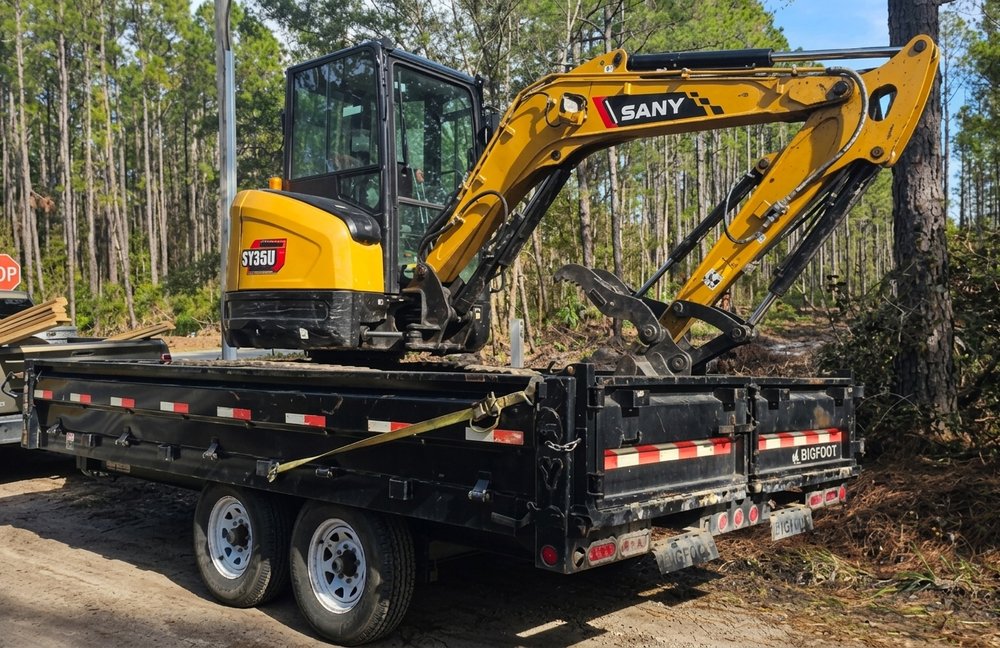

Common questions about land clearing on St. Simons Island
Island clearing is selective clearing. Here is what owners ask us.
Almost never the whole lot. Glynn County's tree protection ordinance covers mature live oaks and other specimen trees, and on St. Simons that is most of the canopy. A building site is cleared selectively: understory, palmetto, small pines and volunteer hardwoods come out, the protected oaks stay, and the house is sited around them. We plan the clearing with that in mind from the first visit.
St. Simons is unincorporated, so a land disturbance permit comes from Glynn County Community Development, and tree removal of a protected tree needs its own approval. We tell you what the lot needs before we quote.
Then the conversation is with the county and your designer, not with a chainsaw. Moving the footprint a few feet is usually cheaper and faster than the approval to remove a specimen oak, and the finished lot is better for it.
Georgia's coastal marsh rules set a buffer along the marsh edge where ground disturbance is restricted, and lots along Dunbar Creek, Village Creek and the Frederica River all have one. We stay out of it. Trimming and light hand clearing inside the buffer is a separate question that goes through the state, and we will point you to the right office rather than guess.
No. Open burning on a residential lot on St. Simons is not practical or welcome, and the county and Forestry Commission rules make it a poor idea. We mulch the understory in place where you want ground cover, or haul it off the island.
A forestry mulcher working through palmetto and understory is far gentler on roots than an excavator grubbing stumps. Near the keeper oaks we mulch rather than grub, hand-cut close to the trunk, and keep the machine's tracks off the root zone as much as the lot allows.